Property Guides
Buying or leasing commercial space in Dhaka: a practical guide for businesses
A guide for businesses choosing office or commercial space in Dhaka, covering business districts, buying versus leasing, approvals and fire safety, building specifications, lease terms and real costs.
An office is more than an address on a business card. It decides how long your staff spend commuting, how easily clients can reach you, how much you pay each month beyond the rent, and whether your business can keep running during a power cut. In Dhaka, where a wrong choice can lock a company into years of traffic and high service charges, the decision deserves the same care as any major investment.
Aakash Developments built Aakash Square, a 13-storey commercial building in Tejgaon, and has commercial projects under construction in Gulshan and Dhanmondi. This guide draws on the questions businesses ask us when they are choosing space, whether they plan to buy a floor or lease one.
Start with what your business needs
Before you look at a single building, write down what the space must do. Count the people who will work there today and the number you expect in three to five years. Note how often clients visit, and whether those visits need a reception area, meeting rooms or a ground-floor counter. A bank branch, a clinic and a software company need very different spaces even when the square footage is the same.
List your technical needs too. Some businesses need heavy floor loading for archives, strongrooms or server racks. Others need 24-hour access, a dedicated generator supply or space on the roof for telecom equipment. Knowing these needs early stops you from falling for a building that cannot support them.
Dhaka’s main business districts
Dhaka has no single central business district. Companies spread across several areas, each with its own character.
Motijheel
Motijheel is Dhaka’s traditional financial district and home to the head office of Bangladesh Bank along with many bank and insurance headquarters. Metro Rail Line 6 ends here, giving a direct rail link north to Farmgate, Agargaon, Mirpur and Uttara. Many buildings are older, which can mean lower rents and also older lifts, wiring and fire systems.
Gulshan
Gulshan Avenue and the areas around the Gulshan-1 and Gulshan-2 circles host the offices of many multinational companies, banks and development organisations, with most of Dhaka’s embassies nearby. A Gulshan address carries prestige with international clients, and rents are among the highest in the city.
Banani
Banani has grown into one of Dhaka’s main business districts, with offices, hotels and restaurants along Kemal Ataturk Avenue and the roads around it. Companies such as The Premier Bank and Maasranga Television have their head offices here. The Banani ramp of the Dhaka Elevated Expressway gives a fast route to the airport.
Tejgaon and Karwan Bazar
Tejgaon Industrial Area sits between Gulshan and central Dhaka. Once a manufacturing zone, it now holds many office buildings on former factory plots. The Tejgaon Industrial Area Thana, formed in 2006, covers 4.38 square kilometres. Its position gives quick access to Gulshan, Hatirjheel, Farmgate and the airport road.
Next door, Karwan Bazar is home to many media houses and corporate offices. It has a Metro Rail Line 6 station, and a Karwan Bazar ramp on the Elevated Expressway opened in March 2024.
Dhanmondi
Dhanmondi’s main roads, especially Satmasjid Road, Road 27 and Mirpur Road, carry a large number of clinics, schools, training centres, showrooms and offices. For businesses serving families and students, Dhanmondi puts you close to a large residential population.
Uttara and the north
Uttara and the areas along the road to Purbachal have attracted offices that want to be near the airport or near northern residential areas. Metro Rail Line 6 starts at Uttara North, and the expressway links the airport area to Banani and Farmgate.
Buy or lease?
Leasing keeps your capital free for the business and lets you move as you grow. You pay an advance or security deposit and monthly rent, and the landlord carries the cost of major repairs to the building. The downside is exposure to rent increases and the risk that the landlord will not renew.
Buying a floor or part of a floor turns a monthly expense into an asset. Your occupancy cost becomes predictable, you control the space and you can lease it out if you move. Buying also ties up capital, adds registration costs, and makes you responsible for your share of the building’s long-term upkeep through the owners’ association.
A simple test helps. If your business expects to stay in one area with stable headcount for many years, buying can make sense. If you expect fast growth, frequent restructuring or a move within a few years, leasing gives you room.
Check that the building is approved for your use
This step is the one most often skipped, and it can have the worst consequences. A building approved by RAJUK for offices is not automatically approved for a restaurant, a clinic, a showroom or a training centre. The Detailed Area Plan sets land use for each zone, and the building’s approved plan sets the use of each floor.
The fire on Bailey Road on 29 February 2024 showed what happens when approved use and actual use diverge. Forty-six people died. According to Prothom Alo, the Green Cozy Cottage building had approval for commercial offices on its lower floors and residential use on the eighth floor, yet eight restaurants were operating inside, and the building had only one staircase. Prothom Alo also reported that the building had no occupancy certificate.
Before you commit, ask for the RAJUK-approved plan and check the approved use of the floor you want. Ask whether the building has an occupancy certificate. If your business needs a trade licence, a fire licence or a sector-specific licence, confirm that the building’s approvals will support the application. If a landlord or seller cannot show these documents, treat that as a reason to walk away.
Building specifications that matter
Two buildings with the same rent per square foot can differ hugely in how well they serve a business. These are the specifications to check on every visit.
Floor plate and efficiency
Ask for the gross floor area and the usable area separately. Lift cores, stairs, shafts and common lobbies take up part of every floor, and the share varies between buildings. A floor with a regular shape and few internal columns is easier to plan and wastes less space. Check the clear ceiling height as well, since ducts, cable trays and false ceilings eat into it.
Lifts and vertical movement
Count the lifts and compare them with the number of people who will use the building. Long waits at 9 in the morning become a daily frustration for staff and visitors. A separate service lift or goods lift keeps deliveries away from passenger traffic. Ask about maintenance contracts and the age of the equipment.
Power and cooling
Dhaka businesses depend on reliable power. Ask whether the building has its own electrical substation, the capacity of the backup generator and how much of that capacity is allocated to your floor. Find out whether the building has central air conditioning, or whether tenants install their own units, and where outdoor units can go.
Fire and life safety
Count the staircases and check that fire stairs are enclosed, signposted and free of storage. Ask about fire doors, alarms, extinguishers, hydrants and sprinklers. The Bangladesh National Building Code 2020, published in the official gazette in February 2021, classes a building of ten storeys or 33 metres and above as multi-storey, with stricter requirements. Ask the building manager when the last fire drill took place.
Parking and access
Ask how many parking spaces come with the space and whether visitor parking exists. In Gulshan, Banani and Tejgaon, a building with too few spaces pushes cars onto the road and frustrates clients. Check access for people with disabilities, the security arrangements at the entrance and the hours when the building is open.
Connectivity and signage
Ask which internet providers already have fibre in the building, since having more than one gives you a backup. Clarify whether you can put your company name on the building’s façade or in the lobby, and at what cost.
Understand the full cost
The headline rent or price per square foot is only the start. For a lease, add the service charge, which typically covers security, cleaning, common-area electricity, lift maintenance and generator fuel. Add the advance or security deposit, your fit-out cost for partitions, flooring, lighting and air conditioning, and the cost of utility connections. Rent paid by companies and institutions also carries VAT and tax deducted at source under Bangladesh’s VAT and income tax laws. Rates and the rules on who deducts them change with each budget, so confirm the current position with your tax adviser before you sign.
For a purchase, add registration costs. These include stamp duty, registration fee, local government tax and an advance tax on the transfer. The Business Standard reported that the FY2025-26 budget cut combined registration costs from around 14 to 15 percent of deed value to around 8 to 9 percent in many areas. Rates can change again in later budgets, so get a written estimate based on current rates.
Lease terms worth negotiating
A commercial lease in Dhaka usually runs for several years. Read it carefully, and negotiate these points before you sign.
The term and renewal option should be clear, with a right to renew at a pre-agreed formula. Rent escalation should be a fixed percentage at fixed intervals, written into the lease. Ask for a rent-free fit-out period, since preparing an office can take two or three months. Agree how the advance will be adjusted, whether against monthly rent over a set period or refunded at the end. Define who maintains what, including air conditioning units and generator hours. Include a break clause if your plans are uncertain, and agree what condition the space must be returned in when you leave.
Register the lease. Under the Registration Act, 1908, a lease of immovable property for a term exceeding one year must be registered. An unregistered long lease can leave you with weak protection if the building is sold or a dispute arises.
Plan the fit-out before you sign
Fit-out is the work that turns bare floor space into a working office: partitions, ceilings, flooring, lighting, air conditioning, data cabling, washrooms and furniture. It often costs more than businesses expect, and it takes time.
Ask the landlord or building manager for the fit-out rules before you sign. Many buildings require tenants to submit drawings for approval, restrict noisy work to certain hours and set rules on materials and electrical loads. Find out what the space comes with. Some floors are handed over as bare shells, while others include a finished ceiling, lighting or air conditioning.
Choose materials with fire safety in mind. Reports on the Bailey Road fire pointed to flammable materials used in interior decoration, and most of the victims died from smoke and carbon monoxide. Fire-rated partitions and doors, non-combustible ceiling boards, tidy cable management and clear exit routes add little to a fit-out budget and protect everyone in the building. Keep exit routes open on every floor and mark them clearly.
Plan the electrical load with an engineer. Add up air conditioners, servers, kitchen equipment and lighting, and confirm that the building’s supply and your generator allocation can carry them. An overloaded circuit is a fire risk you can remove at the planning stage.
Questions to ask on every site visit
A short list of questions, asked the same way in every building, makes comparison easier. Ask for the approved plan and the approved use of the floor. Ask whether the building has an occupancy certificate and a valid fire licence. Ask how many lifts serve the building and how long the morning wait is. Ask how many hours of generator backup your floor gets and at what load. Ask what the service charge covers and how it has changed over the last few years. Ask who the other tenants are and whether any of them run restaurants or kitchens, which raise the fire risk for everyone in the building. Write the answers down on the spot, and get the important ones in writing before you negotiate.
Due diligence before you buy
Buying commercial space calls for the same title checks as buying an apartment. A lawyer should examine the land title and its chain of deeds, the khatian records, mutation and land development tax receipts, and a non-encumbrance search at the sub-registry office. If the building was developed through a joint venture, confirm that the space you are buying falls in the share of the person selling it, and check the registered power of attorney.
Review the owners’ association rules as well. These can limit how floors are used, set service charges and govern who controls the roof, façade and parking. Ask for any outstanding service charge on the floor you are buying, and whether the seller has existing tenants with leases that will pass to you.
Check the tax requirements too. Prothom Alo reported that the FY2026-27 budget made proof of income tax return submission mandatory for mutation of land and flats in city corporation, pourashava and cantonment areas. Make sure the buyer entity has its return filing in order before the deal closes.
Commercial projects from Aakash
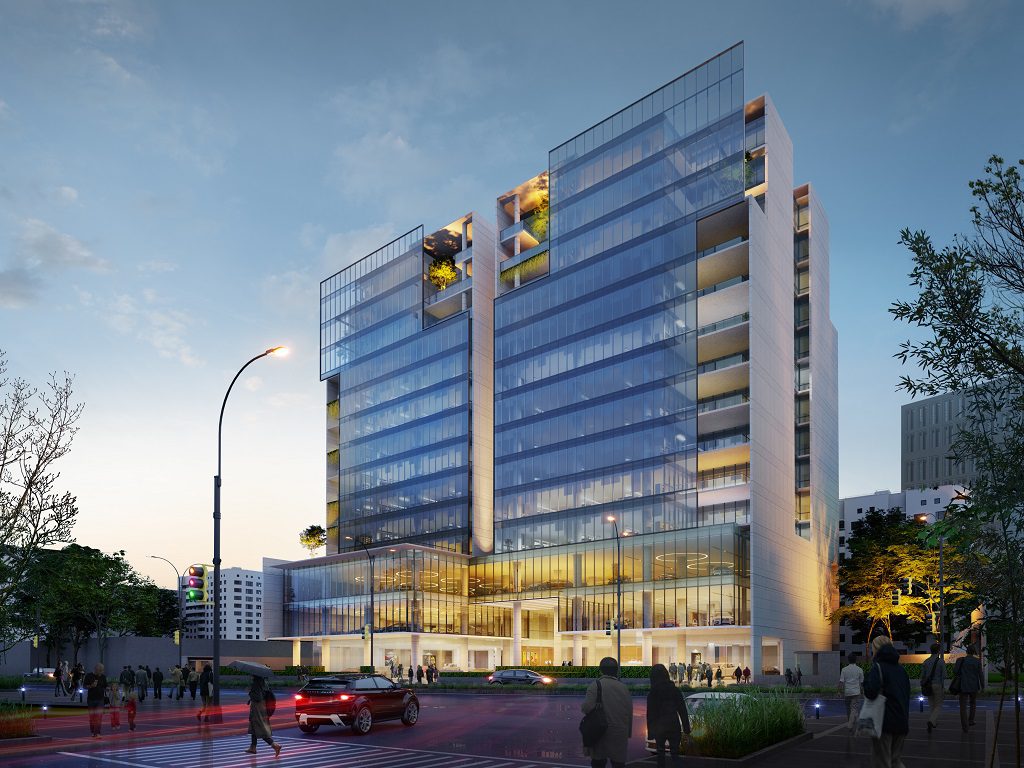
Aakash Square is a 13-storey commercial building in Tejgaon, designed to house financial institutions, corporate offices and telecommunication service providers. Its design includes natural daylighting, good air ventilation and non-toxic, eco-friendly materials, and its Tejgaon location gives easy access to Gulshan and central Dhaka.
Two more Aakash commercial buildings are under construction. Aakash Signature in Gulshan 1 stands on 10.84 katha of land with three basements and 13 floors above ground. Shamsul Aakash Center in Dhanmondi stands on 10 katha, with three basements, 14 floors above ground and an east-facing frontage.
Aakash building designs are submitted to and approved by RAJUK, our structures follow the Bangladesh National Building Code, and our service continues after handover. See the details on our ongoing commercial projects page, call 01879-336666, email info@aakashgroupbd.com or contact our team to arrange a visit.
Choosing with confidence
The right commercial space fits your business today, leaves room for growth and sits in a building approved for the way you will use it. Check the approved use, walk the fire stairs, read every clause of the lease or sale agreement, and ask for each claim in writing. A few weeks of careful checking protects years of business that will happen inside those walls.
This article is general information and is not legal, tax or financial advice. Regulations, tax rates and registration costs change, so confirm current requirements with qualified advisers before you sign.